Measure the teaching space
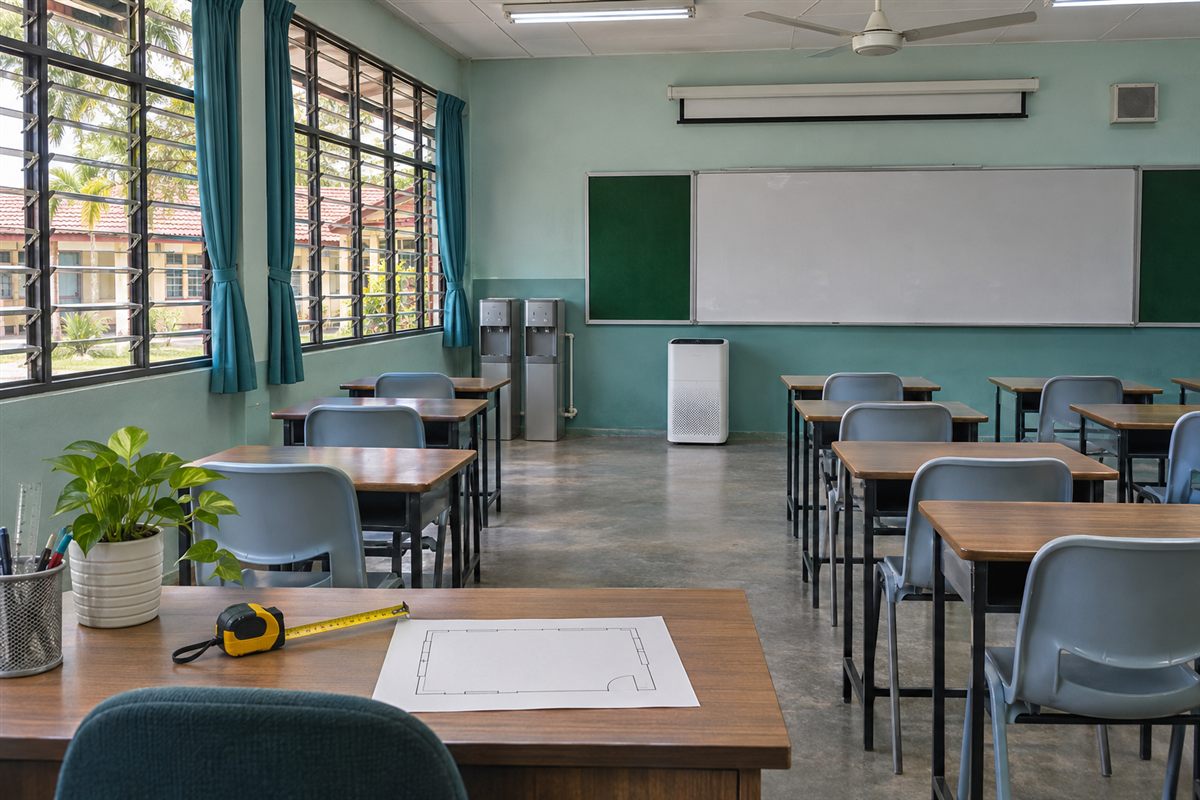
Measure the usable enclosed length, width and ceiling height. Note connected areas and the normal positions of doors and windows.
A purifier recirculates air through a filter; it does not supply outdoor air. Review ventilation and pollutant sources alongside particle filtration.
Worked example with stated assumptions
Hypothetical classroom: 8 m long × 6 m wide × 3 m high = 144 m³. Assume four equivalent air changes per hour from portable particle filtration alone.
Required CADR = 144 m³ × 4 per hour = 576 m³/h. Conversely, a verified CADR of 600 m³/h gives 600 ÷ 144 = about 4.17 equivalent air changes per hour under the simplified well-mixed-room assumption.
Four is an illustrative planning choice, not a classroom safety guarantee or local regulatory requirement.
Interpret the result carefully
The US EPA explains that CADR relates to particle cleaning, that larger rooms need higher delivery and that lower fan speeds reduce filtration. The volume calculation here makes the ceiling-height assumption explicit.
Multiple units can be compared by summing their supported CADRs as a first estimate, but layout and mixing still matter. Do not add unverified ventilation performance to claim a guaranteed total.
Make the classroom workable
Check speaking comfort, clear routes between desks and intake clearance at the intended speed. Record who checks filters and restores settings after cleaning.
If the only adequate speed disrupts teaching, compare another arrangement and repeat the room assessment.
Put it into practice
Your planning worksheet
A sourced calculation with stated room-volume and air-change assumptions.
| Sizing worksheet | Value |
|---|---|
| Length × width × height | 8 × 6 × 3 m, hypothetical |
| Room volume | 144 m³ |
| Assumed purifier-equivalent air changes | 4 per hour; choose and justify for your assessment |
| Required CADR | 576 m³/h at the intended speed |
| Placement and sound | Check in the furnished classroom |
Sources & context
- US EPA — Guide to Air Cleaners in the Home, second edition
Supports the distinctions between particle CADR, gas filtration, operating speed and clear airflow. Residential technical principles are used here for operational planning, not as workplace or clinical compliance criteria.
- US CDC / NIOSH — How Much Ventilation Is Enough?
Explains air changes and equivalent clean-air delivery. GAGE’s four-change examples are arithmetic illustrations, not this source’s recommended target; CDC discusses aiming for five or more total clean-air changes where possible in its stated context.
Sources checked 9 November 2026. Worksheets are editorial planning tools. Confirm site-specific requirements, current local guidance and the instructions for the equipment you use.
Further reading
Elibuy’s room-size and CADR calculator
For an interactive calculation, enter your room dimensions in this household-focused tool. Its default is 4.8 air changes per hour; this GAGE worksheet uses four as an illustrative assumption. Use the rate appropriate to your assessment, rather than treating either figure as a classroom requirement.